
The Role of AI in Digital Marketing: How Artificial Intelligence Is Transforming Marketing in 2026
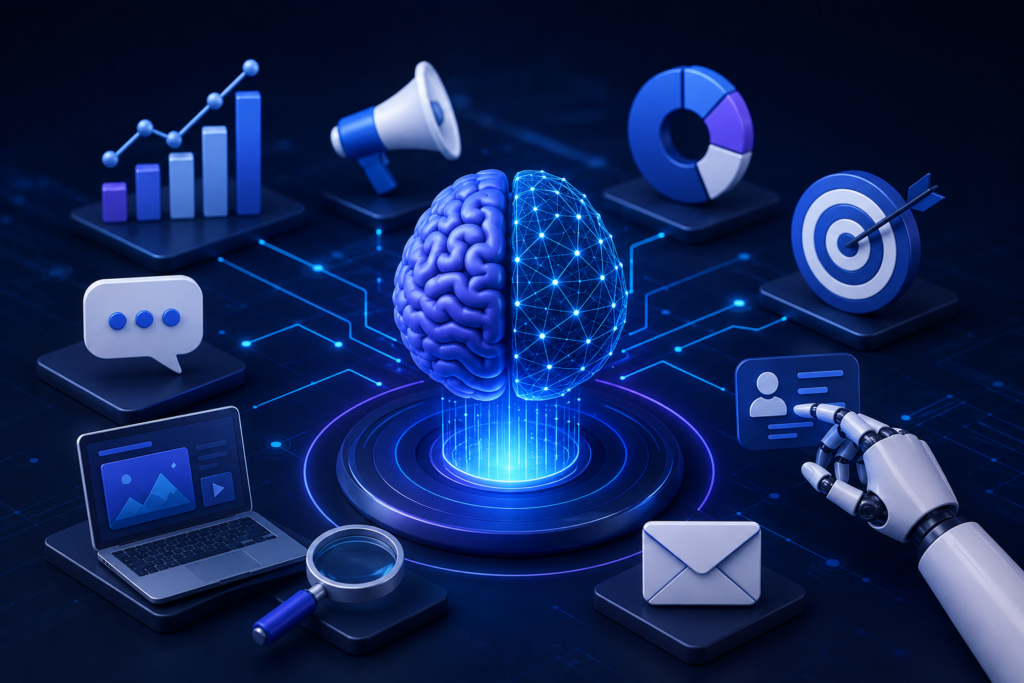
Artificial intelligence has moved from being an emerging technology to becoming a practical part of online marketing. Companies now use AI to study audiences, improve campaigns, automate routine activities, and deliver content that is more relevant to individual customers.
The growth of digital platforms has also changed customer expectations. People want quick answers, useful recommendations, and consistent experiences across websites, search engines, social media, and email. Managing these demands manually can be challenging. AI gives marketers the ability to process large amounts of information and identify useful patterns much faster.
However, AI is not a substitute for marketing professionals. It works best as a supporting technology that handles repetitive and data-intensive tasks while humans remain responsible for creativity, strategy, communication, and judgment.
AI in Digital Marketing: What Does It Mean?
AI in digital marketing involves applying intelligent software to different marketing activities. Technologies such as machine learning, language processing, predictive analytics, and automation can help businesses understand their customers and improve marketing decisions.
Common applications include:
- Customer and audience analysis
- Content development
- SEO research
- Advertising optimization
- Social media management
- Email automation
- Lead generation
- Performance measurement
- Customer support
The result is a marketing process that can respond more quickly to customer behaviour and campaign data.
Why Is AI Becoming Important?
Businesses have access to more customer information than ever before. The challenge is turning that information into useful marketing decisions.
AI can process data quickly and help marketers recognise patterns that may otherwise take considerable time to discover. It can also automate repetitive processes, allowing marketing teams to concentrate on planning and creative work.
Key advantages include improved targeting, faster analysis, personalised communication, reduced manual effort, and more efficient use of marketing resources.
Key Ways AI Is Used in Marketing
Content Production
AI can help marketers develop article ideas, outlines, social media copy, product descriptions, email drafts, scripts, and advertising variations.
It should be treated as a starting point rather than a replacement for professional writing. Human review is needed to check facts, originality, tone, and brand consistency.
SEO
AI-powered tools can make SEO research faster. They can assist with finding keywords, understanding search intent, comparing competitors, identifying content opportunities, and reviewing technical issues.
Despite these capabilities, successful SEO still requires useful content and an understanding of what searchers actually need.
Personalized Experiences
AI can analyse signals such as browsing behaviour, previous purchases, and customer interests. Businesses can use these insights to provide personalised recommendations, offers, emails, advertisements, and website experiences.
This makes communication more relevant instead of delivering identical messages to every customer.
Chatbots
AI chatbots can handle many basic customer interactions without requiring a human representative for every request. They can answer common questions, collect leads, recommend services, schedule appointments, and guide website visitors.
Complex or sensitive issues can still be transferred to human support staff.
Digital Advertising
AI helps advertising systems analyse campaign data and adjust targeting, bidding, budgets, and ad variations. This can help businesses identify better-performing audiences and reduce inefficient spending.
Email Marketing
AI can improve email campaigns by grouping subscribers, suggesting personalised content, predicting customer interests, recommending products, and identifying suitable sending times.
Automated sequences can also keep potential customers engaged throughout the buying process.
Social Media Management
Managing several social platforms can be time-consuming. AI can assist with content ideas, scheduling, audience analysis, trend discovery, caption creation, and performance tracking.
Marketing teams can then spend more time developing creative strategies and engaging with their audience.
Predictive Analytics
AI can use existing data to estimate possible future outcomes. Businesses may use predictive analysis to identify sales trends, customer churn risks, buying patterns, or campaign opportunities.
These insights allow companies to plan instead of responding only after something happens.
Marketing Automation
AI can automate workflows such as lead follow-ups, customer segmentation, CRM updates, reporting, and social media scheduling. Automation reduces repetitive workloads and helps teams operate more efficiently.
Main Benefits
When implemented correctly, AI can provide:
- Faster marketing processes
- More accurate audience insights
- Personalised customer experiences
- Improved campaign efficiency
- Reduced repetitive work
- Better resource allocation
- Greater ability to scale marketing activities
Challenges and Risks
AI also has limitations. The quality of its results depends heavily on the information it receives. Incorrect data can lead to poor recommendations.
Businesses must also consider privacy, security, transparency, bias, and ethical use. AI-generated content may contain errors, so important information should always be reviewed by a person.
How Businesses Should Use AI
A successful AI strategy should combine automation with human expertise. Businesses should select tools based on genuine marketing needs, verify AI-generated outputs, protect customer information, monitor results, and train employees.
The goal should be to use AI where it adds value rather than adding automation simply because the technology is available.
What’s Next for AI Marketing?
AI is expected to influence marketing through predictive customer journeys, conversational assistants, real-time personalisation, AI-generated multimedia, voice and visual search, and increasingly sophisticated automation.
Companies that adopt these technologies while maintaining authentic communication and customer trust can remain adaptable as the industry evolves.
Conclusion
AI is changing digital marketing by helping businesses understand audiences, automate processes, personalise communication, and improve campaign decisions. Its influence can already be seen in SEO, content, advertising, email, social media, analytics, and customer service.
The most effective approach is not to replace human marketers but to give them better tools. Human creativity, strategic thinking, empathy, and judgment remain essential for meaningful marketing.
Businesses that combine AI capabilities with human expertise and responsible practices can create more efficient campaigns, stronger customer experiences, and sustainable digital growth.
For more digital marketing insights, visit Best Digital Marketer in Malappuram.